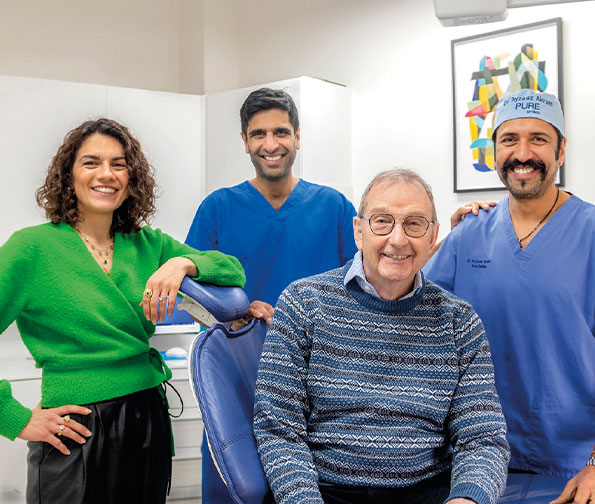
Smiling is one of the simplest things you can do to improve your mental and physical health. Research consistently shows that the act of smiling, even when you do not particularly feel like it, triggers measurable changes in your brain chemistry, cardiovascular function and stress hormone levels.
At Pure Smiles in Fulham, we believe that a healthy smile is not just about straight teeth and clean gums. It is about feeling confident enough to smile freely, because doing so has genuine health benefits.
When you smile, your brain releases three key neurotransmitters: dopamine, endorphins and serotonin. These chemicals work together to elevate your mood, reduce pain perception and promote a sense of calm.
The mechanism works even when the smile is not spontaneous. A study published in Psychological Science found that participants who held their facial muscles in a smile position during stressful tasks had lower heart rates and reported less stress than those who maintained neutral expressions. This suggests that the physical act of smiling sends a feedback signal to the brain that helps regulate the stress response.
After a difficult day, smiling and laughing are among the most accessible ways to lower cortisol levels and break the cycle of tension.
The relationship between smiling and cardiovascular health is more direct than most people realise. When you smile or laugh, your heart rate briefly increases, followed by a period of muscle relaxation. During that relaxation phase, blood pressure decreases.
| Physiological Effect | How Smiling Contributes |
|---|---|
| **Heart rate** | Briefly increases then settles to a lower resting rate |
| **Muscle tension** | Facial and body muscles relax after smiling |
| **Blood pressure** | Decreases as muscles relax and tension is released |
| **Cortisol levels** | Reduced by the endorphin release triggered by smiling |
This does not mean smiling is a substitute for medical treatment for high blood pressure. However, regular, genuine smiling and laughter are recognised as supportive factors in maintaining cardiovascular health.
Endorphins, the chemicals your brain releases when you smile, function as natural painkillers. They bind to opioid receptors in the brain and reduce the perception of pain without the side effects of medication.
Laughter amplifies this effect. Research from the University of Oxford found that sustained laughter increased pain tolerance by up to 10 per cent, likely because it triggers a larger endorphin release than smiling alone. If you are recovering from a workout, dealing with a headache or managing chronic discomfort, smiling and laughing can offer a small but measurable degree of relief.
Studies on facial perception consistently show that smiling faces are rated as more attractive, more trustworthy and younger-looking than neutral or frowning faces.
A study published in the journal Psychology and Aging asked participants to estimate the age of people in photographs. Faces that were smiling were consistently estimated to be younger than the same faces shown with neutral expressions. The effect is thought to be related to the way smiling lifts the facial muscles, particularly around the cheeks and eyes, counteracting the visual cues that people associate with ageing.
If you avoid smiling because you are self-conscious about the appearance of your teeth, this is worth addressing. Cosmetic dental treatments such as learn more teeth whitening, learn more veneers and learn more Invisalign can help you feel confident about your smile, which in turn allows you to access these health benefits more freely.
Smiling is a social signal that communicates openness, warmth and approachability. People who smile regularly tend to be perceived as more confident, more competent and easier to be around.
This perception creates a positive feedback loop. When others respond positively to your smile, it reinforces your confidence, which makes you more likely to smile again. In professional settings, social situations and personal relationships, this cycle has a genuine impact on how you feel about yourself and how others engage with you.
The opposite is also true. People who avoid smiling because they are embarrassed about their teeth often report lower self-esteem and greater social anxiety. Addressing the underlying dental concern, whether it is discolouration, misalignment or missing teeth, can be genuinely transformative for quality of life.
If you find yourself covering your mouth when you laugh or avoiding photographs because of your teeth, you are not alone. It is one of the most common reasons patients come to Pure Smiles for cosmetic consultations.
The solutions are often simpler and more accessible than patients expect:
Each of these treatments can be discussed at a no-obligation consultation.
Pure Smiles has been helping Fulham residents achieve healthier, more confident smiles since 2009. Whether you need a routine check-up, a professional clean or a cosmetic consultation, Dr Ayzaaz Akram (BDS University of Liverpool 1995, GDC 70996) and our team are here to help.
Visit us at either of our two practices:
Call us on 020 7736 6276 or learn more contact us online to book an appointment.
—
Yes. Scientific research has demonstrated that smiling triggers the release of endorphins, dopamine and serotonin, which reduce stress, lower blood pressure and provide natural pain relief. These effects occur even when the smile is deliberately produced rather than spontaneous.
This is more common than you might think, and it is entirely treatable. Cosmetic dental treatments such as teeth whitening, composite bonding, veneers and clear aligners can address the concerns that hold you back from smiling confidently. A consultation at Pure Smiles can help you understand your options.
Professional teeth whitening, when carried out by a qualified dentist, does not damage your enamel. The bleaching agents used in professional treatments are carefully controlled to lighten the colour of your teeth without compromising their structure. Over-the-counter whitening products vary in quality and should be used with caution.
Composite bonding is a minimally invasive treatment that can improve the appearance of chipped, uneven or discoloured teeth in a single appointment. It involves applying a tooth-coloured resin to the affected teeth and shaping it to create a natural-looking result. It is one of the most affordable and accessible cosmetic dental treatments available.