Brushing your teeth correctly reduces the risk of tooth decay and gum disease, allowing you to keep your natural teeth for life. Most people brush daily but still make mistakes that undermine their efforts. This guide covers the technique, timing, and habits that make the difference.
Tooth decay and gum disease are both caused by bacterial plaque, the soft, sticky film that forms on your teeth throughout the day. Effective brushing removes this plaque before it can cause damage. Poor technique leaves plaque behind, particularly in the areas most vulnerable to disease.
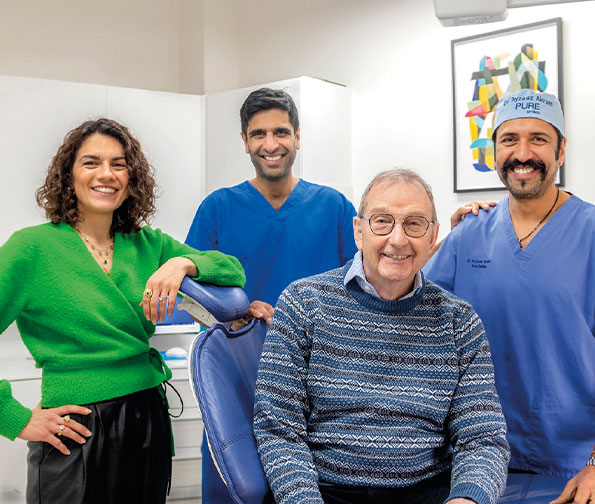
At Pure Smiles in Fulham, our hygiene team sees the same common mistakes repeatedly. The good news is that they are easy to correct once you know what to look for.
| Do | Why |
|---|---|
| Brush first thing in the morning and last thing at night | These are the critical times; saliva flow drops during sleep |
| Brush the inside and outside surfaces equally well | Inner surfaces are neglected by most people |
| Use an electric toothbrush or small circular motions with a manual brush | Both are effective when used correctly |
| See your dentist if your gums bleed | Bleeding indicates gum infection, not over-brushing |
| Spit out toothpaste without rinsing | Keeps fluoride working on your teeth longer |
| Don’t | Why |
|---|---|
| Scrub your teeth with hard back-and-forth strokes | Damages enamel and irritates gums |
| Use your toothbrush for more than 2-3 months | Worn bristles cannot remove plaque effectively |
| Miss the gum line | Bacteria accumulates in the gum crevice |
| Brush immediately after eating | Acid softens enamel; wait at least 30 minutes |
| Rinse with water after brushing | Washes away protective fluoride |
This is arguably the most widespread brushing mistake. When you eat, the bacteria in your mouth produce acid that temporarily softens your tooth enamel. Brushing while enamel is in this softened state accelerates erosion rather than preventing it.
The correct approach: Brush before eating breakfast. If you prefer to freshen up after eating, rinse with plain water or wait at least 30 minutes before brushing.
People naturally concentrate on the teeth they can see when they smile, mainly the front upper and lower teeth. The inner surfaces, the chewing surfaces, and the teeth at the very back of the mouth receive far less attention.
Plaque does not discriminate. It forms on every surface of every tooth. Make a deliberate effort to reach all areas, including the backs of your front teeth and the far surfaces of your last molars.
Plaque bacteria is sticky. Removing it requires firm, straight bristles that can sweep effectively along the tooth surface and into the gum crevice. After two to three months of daily use, bristles splay outward and lose their rigidity. A worn toothbrush can remove significantly less plaque than a new one.
Set a reminder to replace your toothbrush or brush head every two to three months.
The two-times-a-day recommendation is not arbitrary. Here is why each session matters:
During sleep, saliva production drops dramatically. Saliva is your mouth’s natural defence against bacteria, neutralising acids and washing away food particles. By morning, bacterial levels in your mouth have peaked. Brushing first thing removes this overnight buildup before you eat.
The last brushing of the day is the most important. It removes all the plaque and food debris accumulated throughout the day. Crucially, the fluoride from your toothpaste continues to protect your teeth throughout the night when saliva flow is at its lowest.
Brushing alone cleans roughly 60% of your tooth surfaces. The areas between your teeth require additional tools:
Cleaning between your teeth before brushing makes your brushing more effective, as it loosens debris that the toothbrush can then sweep away. Read our guide to interdental cleaning.
If your gums bleed when you brush or floss, this means your gums are infected with bacteria. This is the early stage of gum disease and it is not something to ignore or assume will resolve on its own.
Visit our dentists or hygienists at Pure Smiles for an examination and professional cleaning. Dr Ayzaaz Akram and the hygiene team are available at both our Fulham practices.
Brush for a minimum of two minutes, twice a day. Most people significantly underestimate two minutes. Use a timer or an electric toothbrush with a built-in timer to ensure you are brushing for the full duration.
Research shows that rotating-oscillating electric toothbrushes remove more plaque than manual brushes. However, a manual brush used with correct small circular motions is still effective. The best toothbrush is one you use properly and consistently.
Do not use mouthwash immediately after brushing, as it rinses away the concentrated fluoride from your toothpaste. If you want to use mouthwash, use it at a separate time, such as after lunch.
Adults and children over six should use toothpaste containing 1,350-1,500 parts per million (ppm) fluoride. Children under six should use a lower concentration unless their dentist advises otherwise.
—
Pure Smiles has been providing expert dental care in Fulham since 2009. Book a hygiene appointment at 257 New Kings Road, SW6 4RB or 750a Fulham Road, SW6 5SH by calling 020 7736 6276.