Cerezen is a custom-made ear canal insert that treats temporomandibular joint (TMJ) pain at its nearest access point — the ear canal. These discreet, hollow inserts provide relief from jaw clenching, teeth grinding, and associated headaches without the bulk of a traditional mouth guard.
TMJ disorders affect the joints connecting your lower jaw to the base of your skull, along with the surrounding muscles used for chewing. At Pure Smiles in Fulham, we offer Cerezen as part of our comprehensive approach to treating jaw pain and bruxism.
The temporomandibular joint is one of the most complex joints in the body. It acts as a sliding hinge on each side of your jaw, allowing you to open and close your mouth, chew, speak, and yawn. When this joint or the muscles surrounding it become dysfunctional, the resulting condition is known as temporomandibular disorder (TMD).
TMD is not a single condition but a group of related problems. Causes include bruxism (teeth grinding or clenching), stress, arthritis in the joint, injury to the jaw, or misalignment of the teeth and bite.
| Factor | Detail |
|---|---|
| Prevalence | Estimated 20-30% of the adult population experience symptoms |
| Gender | More commonly diagnosed in women aged 20-40 |
| Peak age | Most frequently presents between 20 and 50 years |
| Associated with stress | Bruxism and jaw clenching often worsen during stressful periods |
| Often undiagnosed | Many people live with symptoms without realising treatment is available |
Cerezen takes a fundamentally different approach to TMD treatment. Rather than fitting inside the mouth like a traditional splint or night guard, Cerezen inserts sit in the ear canal, where they are positioned close to the temporomandibular joint.
The ear canal is the nearest external access point to the TMJ. When you clench or grind your teeth, the shape of the ear canal changes as the jaw muscles contract. Cerezen inserts are designed to apply gentle pressure to the walls of the ear canal during these movements, providing a proprioceptive feedback signal that encourages the jaw muscles to relax.
1. Consultation and assessment — your dentist examines your jaw, reviews your symptoms, and confirms that Cerezen is appropriate for your condition
2. Ear canal impressions — silicone impressions are taken of both ear canals to capture their unique shape
3. Custom manufacture — the impressions are sent to the Cerezen laboratory, where your custom inserts are fabricated
4. Fitting appointment — your inserts are fitted, adjusted for comfort, and you receive full instructions on insertion and removal
5. Follow-up review — a check-up appointment to assess comfort and symptom improvement
Hollow design. The inserts are hollow, allowing full passage of sound. You can hear normally while wearing them, making them suitable for all-day use including at work and during conversations.
Nearly invisible. When fitted, the inserts sit in the outer portion of the ear canal and are practically invisible to others. Small retraction posts allow for easy removal.
Easy to use. You insert and remove them yourself, similar to wearing ear plugs. No special tools or dental expertise required for daily use.
Comfortable for extended wear. Unlike bite splints that can feel bulky and affect speech, Cerezen inserts are worn in the ears and do not interfere with eating, drinking, or talking.
| Feature | Cerezen | Bite Splint/Night Guard | Muscle Relaxants |
|---|---|---|---|
| Worn in | Ear canal | Mouth | N/A (oral medication) |
| Suitable for daytime | Yes | Impractical (affects speech) | Yes, but may cause drowsiness |
| Suitable for sleep | Yes | Yes | Yes |
| Affects eating | No | Must be removed | No |
| Affects speech | No | Yes, can cause lisping | No |
| Custom made | Yes | Yes | N/A |
| Visibility | Nearly invisible | Visible when mouth opens | N/A |
| Mechanism | Proprioceptive feedback | Physical barrier | Chemical relaxation |
Bruxism, the habitual grinding or clenching of teeth, is the most common cause of TMD seen at our Fulham practice. It is divided into two types:
Sleep bruxism occurs unconsciously during sleep and is classified as a sleep-related movement disorder. Partners often notice the grinding sounds before the person themselves becomes aware of it. Symptoms include waking with jaw soreness, headaches, or worn-down teeth.
Awake bruxism involves clenching the jaw during the day, often in response to stress, concentration, or anxiety. Many people are unaware they do it until a dentist points out the signs: worn enamel, flattened tooth surfaces, or muscle tenderness.
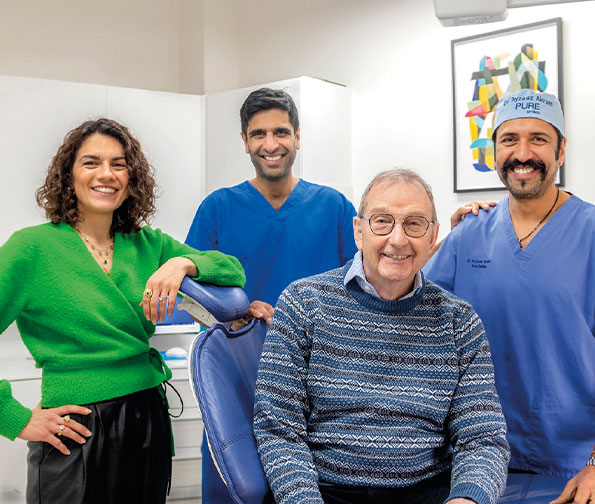
During a routine examination at Pure Smiles, Dr Ayzaaz Akram (BDS Liverpool 1995, GDC 70996) looks for telltale signs of bruxism that you may not have noticed yourself:
Early detection is important. Prolonged bruxism can cause significant damage to teeth, existing dental restorations, and the temporomandibular joint itself.
Many people dismiss jaw pain, clicking, or morning headaches as minor inconveniences. However, untreated TMD can progressively worsen, leading to:
If you experience any of the symptoms listed above regularly, a consultation at Pure Smiles can determine whether TMD is the cause and which treatment approach is most appropriate.
No. Cerezen inserts are custom-made to fit your ear canals precisely, so they should feel comfortable from the first fitting. Some people experience mild awareness of the inserts for the first day or two, similar to wearing new hearing aids, but this passes quickly.
Yes. Cerezen inserts are designed for extended wear. Their hollow construction allows normal hearing, and they do not interfere with eating, speaking, or sleeping. Many patients wear them continuously, removing them only for cleaning.
Many patients report symptom improvement within the first few weeks of use. Clinical studies have shown significant reduction in TMD pain scores after 8-12 weeks of consistent use. Individual results vary depending on the severity and cause of the condition.
Cerezen is most effective for TMD related to muscle tension and bruxism. It may not be the best option for TMD caused by structural joint problems such as disc displacement or arthritis. Your dentist will assess your specific condition and advise whether Cerezen is appropriate for you.
The cost varies depending on the complexity of your case. A consultation at Pure Smiles will include a full assessment and a clear explanation of costs before you commit to treatment.
—
To book a TMJ or bruxism consultation at Pure Smiles, call 020 7736 6276. Visit us at 257 New Kings Road, SW6 4RB or 750a Fulham Road, SW6 5SH.