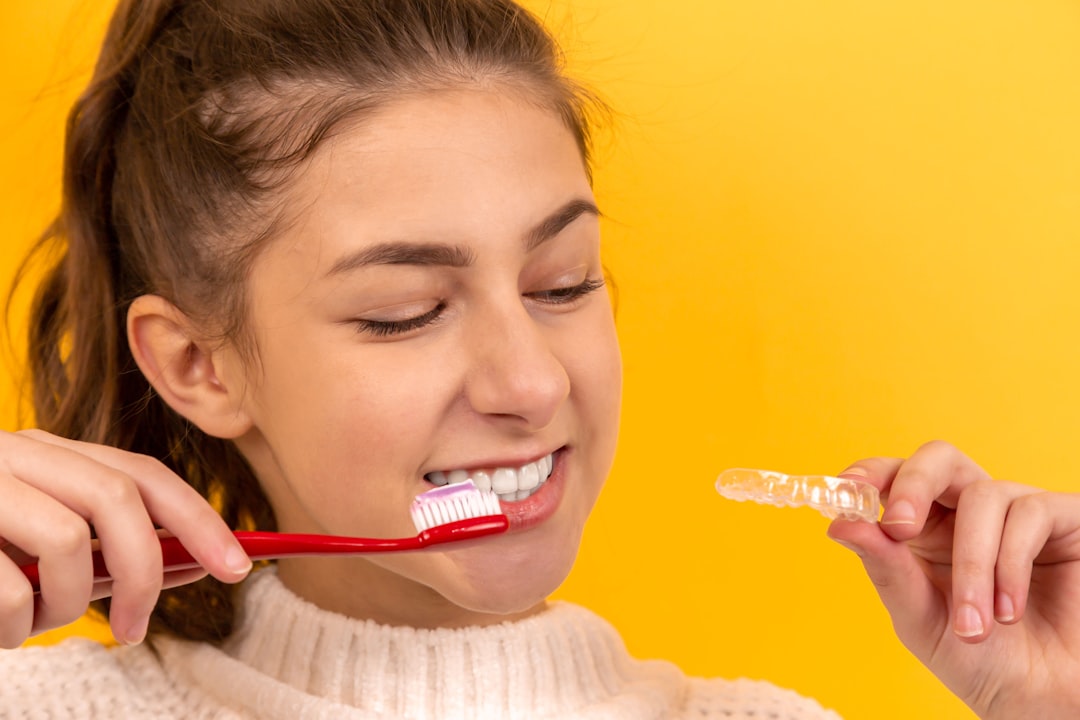
It is never too late to straighten crooked teeth. Adult orthodontics has advanced significantly, and options like Invisalign mean you can correct overcrowded or misaligned teeth discreetly, at any age, without a mouthful of metal braces.
Your smile plays a significant role in first impressions, confidence, and everyday happiness. If crooked teeth have been holding you back from smiling freely, here is what you need to know about your options at Pure Smiles in Fulham.
While the cosmetic benefits of straight teeth are obvious, the health advantages are equally important and often overlooked.
Easier cleaning. Crowded or overlapping teeth create tight spaces where plaque accumulates and brushing cannot reach effectively. This increases the risk of cavities and gum disease in those hard-to-access areas.
Better bite function. Misaligned teeth can cause uneven wear on certain teeth, leading to chips, fractures, and premature erosion of enamel. A properly aligned bite distributes chewing forces evenly across all teeth.
Reduced jaw strain. A poor bite (malocclusion) can contribute to temporomandibular joint (TMJ) problems, causing jaw pain, headaches, and clicking or grinding. Orthodontic correction addresses the root cause rather than just managing symptoms.
Improved gum health. Teeth that are properly spaced and aligned are better supported by the surrounding bone and gum tissue. Crowded teeth can cause gum tissue to become inflamed and harder to keep clean.
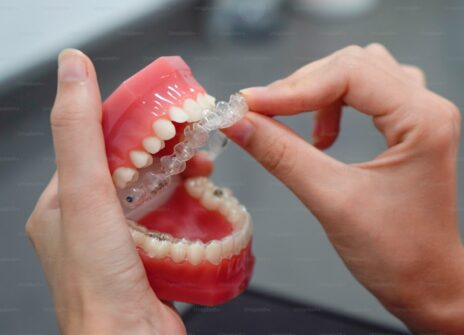
Invisalign is the most popular choice among adult patients at Pure Smiles, and for good reason. The system uses a series of custom-made, clear plastic aligners that gradually reposition your teeth over a planned treatment period.
1. Digital scanning — a 3D scan of your teeth replaces traditional messy impressions
2. Treatment planning — specialised software maps the precise movement of each tooth from start to finish
3. Preview your results — you can see a digital simulation of your final smile before treatment even begins
4. Aligner series — you receive a series of custom aligners, changing to the next set every one to two weeks
5. Progress checks — regular appointments at Pure Smiles to monitor movement and provide your next aligners
| Feature | Invisalign | Traditional Metal Braces |
|---|---|---|
| Visibility | Nearly invisible | Clearly visible |
| Removable | Yes, for eating and cleaning | No, fixed for duration |
| Comfort | Smooth plastic, minimal irritation | Brackets and wires can cause sores |
| Eating restrictions | None (remove aligners to eat) | Avoid hard, sticky, crunchy foods |
| Cleaning | Normal brushing and flossing | Requires special tools around brackets |
| Treatment time | Typically 6-18 months | Typically 12-24 months |
| Best for | Mild to moderate misalignment | Complex orthodontic cases |
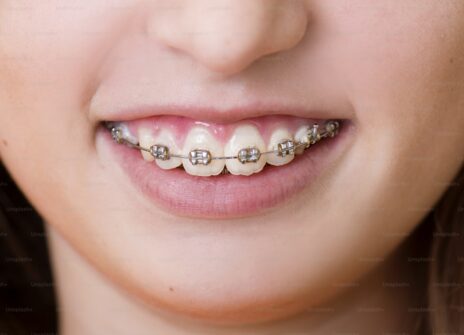
Traditional fixed braces remain the best solution for more complex orthodontic problems. Modern braces are significantly smaller and more comfortable than the bulky brackets of previous decades. Ceramic (tooth-coloured) brackets offer a more discreet alternative to metal while still providing the control needed for complex tooth movements.
Fixed braces work by applying constant, gentle pressure through a wire threaded through brackets bonded to each tooth. The wire is tightened or replaced at regular intervals to continue guiding teeth into their planned positions.
Adult orthodontics is not identical to childhood treatment. There are specific considerations that your dentist will assess before recommending a treatment plan.
Adult bone is denser and less malleable than the bone in growing teenagers. Teeth can still be moved effectively, but the process may take slightly longer, and permanent retention is almost always necessary after treatment. This typically means a thin wire bonded behind your front teeth (a fixed retainer) or a removable retainer worn at night.
Without retention, teeth have a natural tendency to drift back toward their original positions. This is not a failure of treatment — it is normal biology. Following your retention plan is essential for long-term results.
Before starting orthodontic treatment, your dentist must ensure that your gums and supporting bone are healthy. Active gum disease must be treated first, as moving teeth through inflamed or compromised tissue can worsen the problem. At Pure Smiles, Dr Ayzaaz Akram (BDS Liverpool 1995, GDC 70996) carries out a thorough assessment including gum health, bone levels, and any existing dental work before recommending orthodontic treatment.
Adults often have crowns, bridges, veneers, or implants that need to be considered in the treatment plan. Invisalign attachments cannot bond to porcelain crowns as reliably as to natural enamel, and implants cannot be moved orthodontically because they are fused directly to bone. Your treatment plan will account for all existing restorations.
Research consistently shows that people who are unhappy with their smile avoid showing their teeth in photographs, cover their mouth when laughing, and may hold back in social and professional situations. Straightening your teeth is not vanity — it is an investment in your confidence and quality of life.
At Pure Smiles, we see the transformation regularly. Patients who have spent years hiding their smile often tell us that the change in their confidence was even more significant than the change in their appearance.
A teeth straightening consultation at Pure Smiles involves:
We believe in providing all the information you need to make a confident decision about your treatment.
No. There is no upper age limit for teeth straightening. As long as your gums and supporting bone are healthy, orthodontic treatment can be effective at any age. Many of our patients at Pure Smiles are in their 40s, 50s, and beyond.
Treatment duration depends on the complexity of your case. Simple alignment issues may be resolved in as little as six months, while more significant corrections typically take 12 to 18 months. Your dentist will give you an accurate timeline at your consultation.
You may experience mild pressure or discomfort for the first few days after starting a new aligner or after a brace adjustment. This is normal and indicates that your teeth are moving. Over-the-counter pain relief is usually sufficient, and the discomfort subsides quickly.
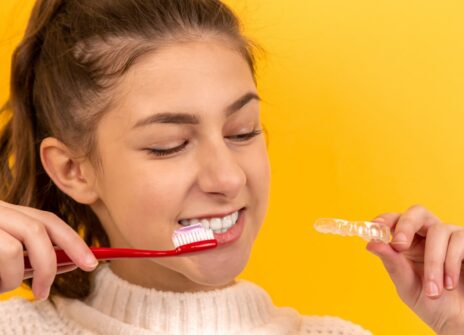
Yes. Invisalign aligners are removed for eating and drinking anything other than water. There are no dietary restrictions. You simply remove the aligners, eat normally, brush your teeth, and put them back in.
—
To book an orthodontic consultation at Pure Smiles, call 020 7736 6276. Visit us at 257 New Kings Road, SW6 4RB or 750a Fulham Road, SW6 5SH.