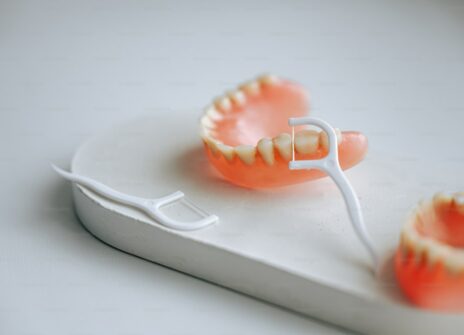
Flossing removes plaque and food debris from between your teeth and below the gum line — areas that a toothbrush cannot reach. Brushing alone cleans approximately 60% of your tooth surfaces. Without flossing, the remaining 40% accumulates plaque that hardens into tartar, leading to gum disease, tooth decay and bad breath.
Flossing is not optional. It is an essential part of a complete oral hygiene routine, recommended by the NHS, the British Dental Association and every dental professional at Pure Smiles in Fulham.
Plaque is a sticky film of bacteria that forms on teeth throughout the day. When plaque is not removed from between teeth, it mineralises into tartar (calculus) within 24-72 hours. Tartar can only be removed by a dental hygienist — you cannot brush or floss it away once it has hardened.
Daily flossing breaks the cycle by removing plaque before it calcifies. learn more
Gum disease (periodontal disease) affects approximately 55% of UK adults. It begins as gingivitis — red, swollen gums that bleed when brushed — and can progress to periodontitis, which destroys the bone supporting your teeth and is the leading cause of adult tooth loss.
Flossing removes the bacteria that cause gum disease from the spaces a toothbrush misses. learn more
Bad breath (halitosis) is frequently caused by bacteria and decomposing food particles trapped between teeth. No amount of mouthwash will resolve bad breath if the source — inter-dental plaque — remains in place. Flossing eliminates the cause rather than masking the symptom.
Cavities do not only form on the biting surfaces of teeth. Inter-proximal cavities — those that develop between teeth — are among the most common types and often go unnoticed until they cause pain or are detected on an X-ray. Flossing prevents these cavities by keeping the spaces between teeth clean.
Research published in the European Journal of Preventive Cardiology (2019) found that regular flossing and good oral hygiene are associated with a reduced risk of cardiovascular disease and heart failure. The link between oral bacteria and systemic inflammation means that looking after your gums has benefits well beyond your mouth.
Flossing technique matters. Done incorrectly, flossing can be ineffective or even damage gum tissue.
| Step | Instruction |
|---|---|
| 1 | Take approximately 45cm of floss and wind most of it around one middle finger, with a small amount around the opposite middle finger |
| 2 | Hold the floss taut between your thumbs and forefingers with about 2-3cm of floss between them |
| 3 | Guide the floss gently between your teeth using a zigzag motion — do not snap it into the gums |
| 4 | Curve the floss into a C-shape against one tooth and slide it gently under the gum line |
| 5 | Move the floss up and down against the tooth surface 2-3 times |
| 6 | Repeat on the adjacent tooth, then move to the next gap using a fresh section of floss |
| Tool | Best For |
|---|---|
| Traditional floss | Most people; offers the best control and reach |
| Interdental brushes (TePe) | Larger gaps between teeth; easier for those with limited dexterity |
| Water flosser | Patients with braces, implants or bridges |
| Floss picks | On-the-go convenience, though less effective than traditional floss |
If you find traditional floss difficult to use, ask our hygienists at Pure Smiles for a demonstration and personalised recommendation. The best flossing method is the one you will actually use every day.
Floss at least once per day, ideally before brushing your teeth at night. Flossing first loosens plaque and debris, allowing fluoride toothpaste to reach more of the tooth surface when you brush.
| Common Question | Answer |
|---|---|
| Should I floss before or after brushing? | Before — loosens debris for brushing to remove |
| Is once a day enough? | Yes — once daily is effective for plaque removal |
| Should I floss if my gums bleed? | Yes — bleeding is usually a sign of gum inflammation caused by insufficient flossing. It typically stops within 1-2 weeks of regular flossing |
| Is it too late to start flossing? | It is never too late. Benefits begin immediately |
Our dental hygienists provide professional cleaning, personalised oral hygiene instruction and can demonstrate the best flossing technique for your teeth. Regular hygiene appointments at Pure Smiles complement your daily routine and help prevent gum disease before it starts.
| Practice | Address |
|---|---|
| New Kings Road | 257 New Kings Road, Fulham, SW6 4RB |
| Fulham Road | 750a Fulham Road, Fulham, SW6 5SH |
| Phone | 020 7736 6276 |
No. Flossing and brushing serve different functions. Brushing cleans the outer, inner and biting surfaces of teeth. Flossing cleans the sides of teeth and below the gum line where the toothbrush cannot reach. Both are essential.
Bleeding gums when flossing are usually a sign of gingivitis — early-stage gum disease caused by plaque build-up. Regular daily flossing reduces inflammation and bleeding typically stops within one to two weeks. If bleeding persists, book a check-up at Pure Smiles.
Water flossers are effective at removing loose debris and are useful for patients with braces, implants or bridges. However, traditional floss and interdental brushes are generally more effective at disrupting the bacterial biofilm on tooth surfaces. Your hygienist can advise which method suits your teeth best.
Children should begin flossing as soon as they have two teeth that touch — typically around age two to three. Parents should help with flossing until the child has the dexterity to do it properly, usually around age eight to ten. learn more